- Customer Profile Update
- Pin Change for Retail Debit and Credit Cards
- Implemented a NotebookLM for Content Generation, Editing, and Gap Analysis
Customer Profile Update
Context
Role: Content Designer
Team: Project Manager, UX Designer, Product Owner, Quality Assurance, Developer
Duration: 3 months
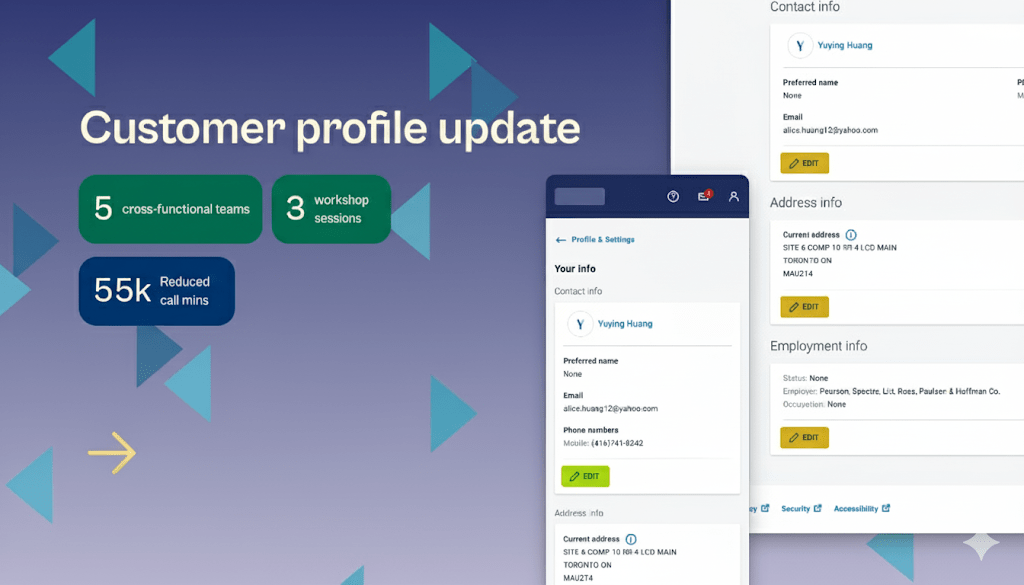
The Business/User Problem: The initiative was primarily launched to achieve compliance with one of Canada’s financial regulator, the Office of the Superintendent of Financial Institutions (OSFI). Simultaneously, Bank of Montreal aimed to resolve a major pain point: the lengthy and expensive process of updating customer information. Before this project, calls for simple information updates often lasted 10-15 minutes, creating a significant burden on customer service. By digitizing and streamlining this process across all platforms, the bank planned to realize substantial cost savings while enhancing the overall customer experience. Before this update, customer profiles could not be updated in the BMO Banking app.
Problem Statement
The Research/Diagnosis: The diagnosis focused on customer service data, which showed that calls for simple information updates were a major bottleneck, averaging 10-15 minutes. This long duration was the root cause of high operational costs and poor customer experience, driven by an outdated reliance on virtual call centers. The project was also mandated by the OSFI to ensure data compliance and required an expansion to the mobile channel to provide a consistent, modern, and efficient self-service solution.
Problem Statement: Bank of Montreal needed to digitize and unify the customer information update process across mobile and web platforms to comply with the OSFI mandate, eliminate the lengthy 10−15 minute customer service calls, and significantly reduce operational costs.
Solution
1. Alignment and Feedback: The first step was to foster alignment among cross-functional stakeholders to ensure early feedback and buy-in on the critical process changes.
2. Product Definition (MVP): The core strategy was to Launch a Minimum Viable Product (MVP) in the first phase. This MVP focused on the essential functionality required to meet the OSFI mandate and enable the basic information update process on both mobile and web.
3. Technical Transition: The most complex step was the technical execution: transitioning the customer information update process from virtual call centers to digital channels. This involved developing new APIs and backend connections to securely process and reflect customer updates.
4. Rigorous Testing (Integrity Assurance): Before launch, rigorous testing was required to ensure that updates were processed correctly and accurately reflected in the new experience, thereby maintaining the integrity of customer information (a core compliance requirement).
5. Platform Expansion: The final step was the strategic expansion to the mobile channel, which aligned the bank’s digital offerings to provide a consistent and intuitive experience across all platforms. Future enhancements were planned beyond the initial MVP.
Results and Impact
Quantifiable Metrics: The project yielded substantial and quantifiable results, confirming its success in achieving both financial and operational goals. By digitizing the customer information update process, the bank achieved a month-over-month reduction of approximately ∼55,000 minutes in customer call times, directly translating a 10-15 minute call duration into a near-instantaneous self-service activity. This efficiency, coupled with the enablement of mobile channel updates to comply with the OSFI mandate, contributed to a projected 5-year benefit of significant cost savings, estimated in the range of $\sim $$M.
Key Takeaways/Learnings: The main learning was that fixing a key customer frustration—the slow update process—directly led to major business efficiencies. The team successfully used a Minimum Viable Product (MVP) approach to quickly meet the mandatory OSFI compliance rules and secure immediate cost savings, while planning for future upgrades. Critical to the success was reducing the complexity for users (minimizing cognitive load), but the entire solution was built on rigorous testing to guarantee the accuracy and integrity of customer data as the process moved from old call centers to new digital systems.
High-Fidelity Prototype (Password Required)
“This was not only one of the best experiences I’ve ever worked on, but it was also one of the best examples of collaboration I’ve been part of”
Product Owner, Bank of Montreal
Pin Change for Retail Debit and Credit Cards
Context
Role: Content Designer
Team: Project Manager, UX Designer, Business Analyst, Engineer, Product Owner
Duration: 4 months
The Business/User Problem: Clients needed the ability to reset their debit and credit PINs online without visiting a branch or ATM.
Problem Statement
The Research/Diagnosis: User interviews and customer feedback indicated that customers were frustrated that this feature wasn’t accessible digitally.
Problem Statement: The process for resetting debit and credit PINs was inefficient, relying on in-person visits to a branch or ATM and increasing service volume.
Solution
1. Iterative Co-Design: The initial phase involved creating multiple designs and rapidly iterating on the proposed user flow and interface.
2. Cross-Functional Feedback: Designs were refined based on continuous feedback from the Product team (for functionality), and the Business Analyst who was the primary link to Legal and Compliance (for security and regulatory sign-off).
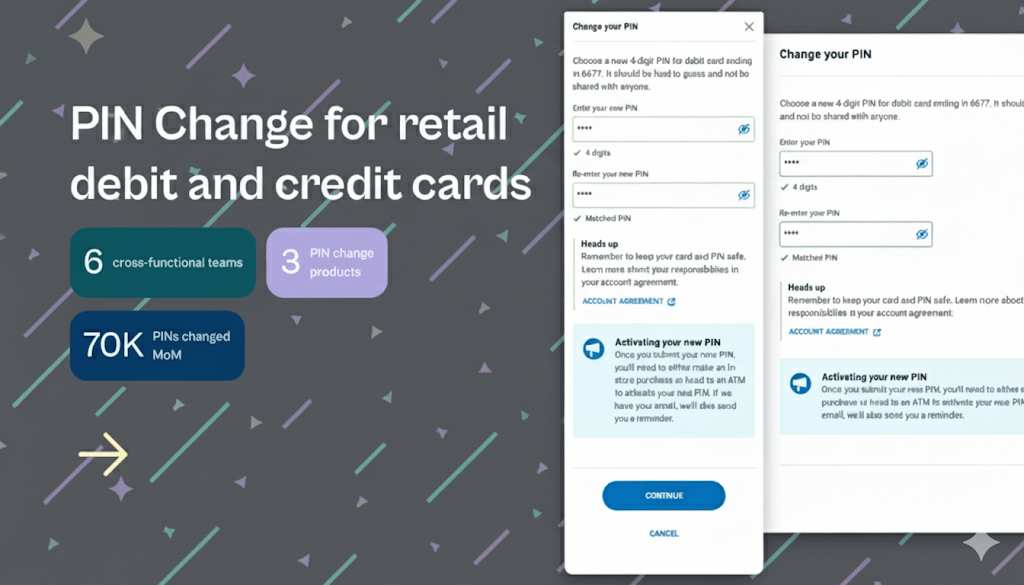
3. Artifact Creation: Key design artifacts included user flows to map out the secure steps a client would take, and wireframes or prototypes to visualize the screen-by-screen experience.
4. Content Design & Compliance: I was responsible for writing all copy for the feature. This required close work with the Business Analyst and Legal to ensure the instructional and confirmation text was clear, secure, and met all necessary regulatory and legal standards.
Results and Impact
Quantifiable Metrics: The successful introduction of the digital PIN reset feature immediately drove high engagement and product usage. The feature quickly scaled to approximately 70,000 PIN changes month-over-month, proving that customers strongly preferred the digital self-service channel. Furthermore, the project required the coordination of six cross-functional teams and successfully enabled the feature across three major product lines (debit cards, credit cards, and business banking cards), demonstrating high product reach and significant scale within the bank’s digital ecosystem.
Key Takeaways/Learnings: The core learning from this project was that high customer demand exists for self-service options, even for high-security tasks like PIN resets, provided the experience is secure and simple. The project’s successful deployment was a testament to the value of an iterative co-design process supported by continuous feedback from six cross-functional teams. Crucially, the intense collaboration with the Business Analyst and Legal/Compliance was mandatory to ensure that the content and user flow were designed for both ease of use and the highest standards of security and regulatory compliance.
“The significant rise in BMO’s mobile app score on both the Apple and Google Play stores directly reflects the success of features like this, which we’re enabling through digital transformation.”
Design Director, Bank of Montreal
Implemented a NotebookLM for Content Generation, Editing, and Gap Analysis
Context
Role: Content Designer, Strategist, Developer
Team: Product Manager, Marketing, Sales, Developers
Duration: Ongoing
The Business/User Problem: The core business problem is the severe knowledge fragmentation impacting our experts and internal partners, as vital information is scattered across a non-centralized repository of over 1,000 articles, leading to increased average handle time (AHT) of our Sales and Experts team when working directly with customers. We required an intelligent, centralized knowledge tool whose primary function is to allow users to pose natural language questions and receive accurate, grounded answers sourced exclusively from this extensive collection of 1,000+ documents. Additionally, we wanted a tool that allowed us the flexibility to add other source material such as websites, YouTube videos and PDFs.
Problem Statement
The Research/Diagnosis: We received feedback from our experts and internal sales team that they often had to put clients on hold while looking up article contents to answer a client’s question.
Problem Statement: Product information is spread across 1000 articles and there is no single repository to ask or engage that source material.
Solution
1. Centralized Knowledge Ingestion and Normalization: The first step is to eliminate fragmentation by building a unified knowledge repository. This involves ingesting all existing content—starting with the over 1,000 articles into a single, secure database. This also includes identifying alternative forms of source material and including it, such as PDFs and YouTube videos. NotebookLM has a maximum source material cap of 300 sources, so a Python script was created to compress 1,000 articles into 12 .txt files that are uploaded directly to NotebookLM on a bi-weekly basis.
2. Continued Maintenance and Monitoring: Information in the articles gets updated all the time, so for the repository to give accurate and up to date information we established a cadence that the NotebookLM source material must be refreshed at least twice a month our of tax season and once a week in season.
3. User Deployment and AHT Reduction Validation: We are currently tracking our AHT and have already seen a MoM and have seen an AHT decrease of 20% for both the Sales and Support teams.
Results and Impact
Quantifiable Metrics: The successful implementation of the centralized knowledge tool yielded significant and measurable improvements in core business operations:
– 20% decrease in Average Handle Time (AHT) Month-over-Month (MoM) for both Sales and Expert Support teams, directly validating the solution’s impact on efficiency.
– 80% reduction in reliance on Subject Matter Experts (SMEs) for routine content clarification and validation (estimated).
Key Takeaways/Learnings: The most significant learning was that the intelligent Q&A tool transcended its initial purpose of AHT reduction to become a foundational productivity platform. Its ability to instantly validate information eliminated the need for manual SME consultation. Furthermore, the tool’s immediate success has expanded its use case across the organization: it is now actively leveraged as the standard training tool for all new employees and has become an essential utility for the content team in creating new content and editing existing content by providing a single source of truth.
“This intelligent Q&A tool has fundamentally changed how we operate. The 20% decrease in AHT is proof of immediate efficiency gains, but the ultimate value is turning our 1,000+ articles and videos into a living source of truth that powers everything from customer support to new employee training.”
Product Manager, Intuit
 Ryan McInally